Product update: By Vilain Powermade has been improved and reformulated as By Vilain Flow Pomade. The original images have been retained and may show the former Powermade product.
Start with detangled, damp curls, distribute your styling product evenly and shape the curls before drying. Once you have the definition you want, handle the hair as little as possible while it dries. Adjust the product amount and drying method to the result: closer definition, softer movement or more volume.
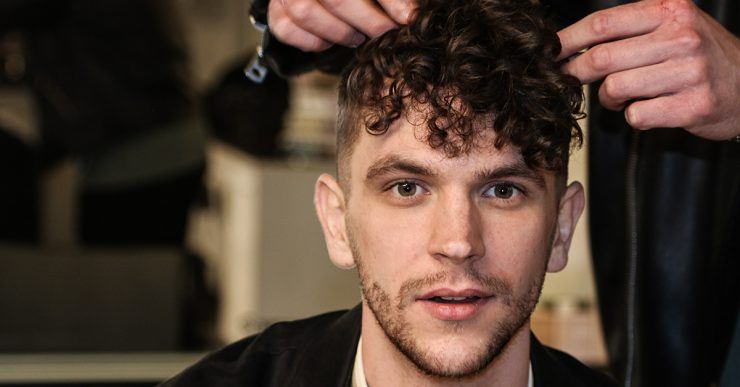
Your curls do not have to be straightened to look deliberate. A good haircut and a repeatable routine let you work with the texture instead of starting a fight with it every morning.

1. Start with a haircut you can reproduce at home
Show your barber how you normally wear your curls. Explain whether you prefer them forward, swept to one side or higher on top, and how much fullness you want at the sides. Reference photos are most useful when the curl pattern is similar to yours.
Discuss the shape as it looks dry as well as wet. There is no compulsory length or one cutting method for every curl pattern. Shorter sides with a longer top are one option; a fuller shape or longer layers may suit the look you want just as well.
2. Wash and condition for your hair’s needs
Use a cleansing routine that addresses scalp oil and product buildup without leaving the lengths difficult to manage. Condition through the lengths and detangle gently. The AAD’s curly-hair guidance recommends working in sections and avoiding dry brushing that breaks up the curls.
A wide-tooth tool such as the By Vilain XL Comb can help you work through knots. Begin at the ends and stop if the comb catches. Follow the conditioner’s instructions, including whether it needs rinsing out.
3. Apply product evenly before refining the shape
Divide dense or longer hair into sections so product reaches more than the outer layer. Use a small amount first, spread it through your hands and work it through the section. Then shape with your fingers, or cup and gently lift the ends to encourage the curls to sit together.
Choose according to the finish you want:
- Soft movement: look for light control and start sparingly.
- Closer definition: try a styling product with more hold, applying it evenly rather than repeatedly coating the surface.
- Less weight at the roots: reduce the amount near the scalp and compare the result when dry.
By Vilain Flow Pomade offers light, flexible hold and natural shine. It is an option for a softer finish, not a dedicated promise of firm curl hold. Browse By Vilain styling products if your preferred result needs a different level of control.
4. Air-dry or diffuse with care
For air-drying, arrange the curls and leave them to settle. If you prefer a diffuser, use low heat and gentle airflow, and avoid repeatedly disturbing the same sections. Use a compatible heat-protectant according to its label.
Compare the finished result rather than assuming one method works for everyone. If the outer layer looks frizzy, try changing how much you touch it during drying before adding another product.

Three starting routines for different curl patterns
Curl pattern is only part of the picture: strand thickness, density, length and previous colour or heat treatments also affect how your hair behaves. Use these routines as experiments, and change one variable at a time.
Loose waves that become flat
Begin with a small amount of styling product on damp hair. Arrange the wave with your fingers, then gently cup the ends upwards. Avoid repeatedly smoothing the top flat while it dries. If the result feels coated, reduce the amount next time before buying a stronger product.

Defined curls that become fluffy
Detangle first, then distribute your styling product through sections rather than coating only the surface. Arrange the curls while damp and leave them to settle as they dry. If you use a diffuser, start with gentle airflow. Compare the result with less handling before adding another product to the routine.

Tight curls or coils that tangle easily
Work in smaller sections with conditioning support. Separate knots gently with your fingers before using a suitable detangling tool, and avoid forcing it through resistance. Shape each section while you can still see and reach it. Ask a stylist experienced in your texture to demonstrate section size and handling if the routine remains difficult.

Match the adjustment to the styling problem
| Problem | First thing to check | Small change to try |
|---|---|---|
| Flat roots and coated ends | Amount and placement of product | Start with less and distribute more evenly |
| Defined underneath, fluffy on top | Surface handling and product coverage | Include the outer sections deliberately, then avoid disturbing them during drying |
| One side dries differently | Section size and drying direction | Work on comparable sections and check your technique on each side |
| Curls disappear after brushing | When you are detangling versus finishing | Detangle before setting the curls; use fingers for the final arrangement |
Take a photo of the dry result and note the product amount and drying method. That gives you something useful to compare on your next wash day. If the issue is ongoing scalp irritation or unexpected breakage rather than the appearance of the style, seek professional advice instead of continuing to layer products.
5. Refresh the parts that need it
Between washes, lightly dampen a flattened section and reshape it with your fingers. If that does not help, try a little of your usual styling product. Avoid automatically repeating the full application over yesterday’s product.
When roots feel coated or the scalp needs cleaning, refresh the routine with a wash rather than continuing to layer products. Keep a note of what you changed so you can repeat the result that worked.
Do all products containing alcohol dry out curls?
No. The word “alcohol” alone does not tell you how a formula will behave. The AAD lists fatty alcohols such as cetyl and stearyl alcohol among conditioning ingredients for curls. Judge the whole product, its intended use and your hair’s response.
Why do my curls look good wet but lose shape when dry?
Check three things: whether the product reached every section, whether the hold suits your chosen shape and how much you disturbed the hair while drying. If the same area remains difficult, show your barber the dry result so you can discuss the cut as well as the routine.
More from the Slikhaar archive