Product update: By Vilain Powermade has been improved and reformulated as By Vilain Flow Pomade. The original images have been retained and may show the former Powermade product.
The best starting point for a new hairstyle is the hair you have and the time you want to spend styling it. Choose a length, decide whether to work with your natural texture, then compare the shapes you like. A sharp crop, a loose middle part and a sculpted pompadour ask for different things from your haircut and your morning routine.
This guide brings together recurring looks from the Slikhaar hairstyle archive. Use the comparisons to narrow your options, then show your barber the details you want to keep.
Compare the main hairstyle options
| Style | Defining feature | Daily styling |
|---|---|---|
| Buzz cut | Very short length throughout | Little shaping; regular trims keep the outline |
| Crew cut | Short sides with slightly more length on top | A small amount of product if you want definition |
| Crop or Caesar cut | A short top and forward fringe | Guide forwards; separate or flatten the fringe |
| Fringe | Hair falls towards or across the forehead | Depends on length, texture and natural direction |
| Quiff or pompadour | Lift at the front or a fuller swept-back shape | Often benefits from shaping with a dryer |
| Side part or slick back | A clear direction across or away from the face | Comb or finger styling; choose shine and hold |
| Curtains or loose middle part | A longer front divided around the face | Guide the part and let the lengths move |
| Curls or natural afro | Natural curl pattern defines the shape | Care and shaping depend on texture and length |
| Shoulder-length hair or a loose bun | Longer lengths worn down or loosely gathered | Detangling and a plan for growing the shape |
Short hair: choose how much texture to keep
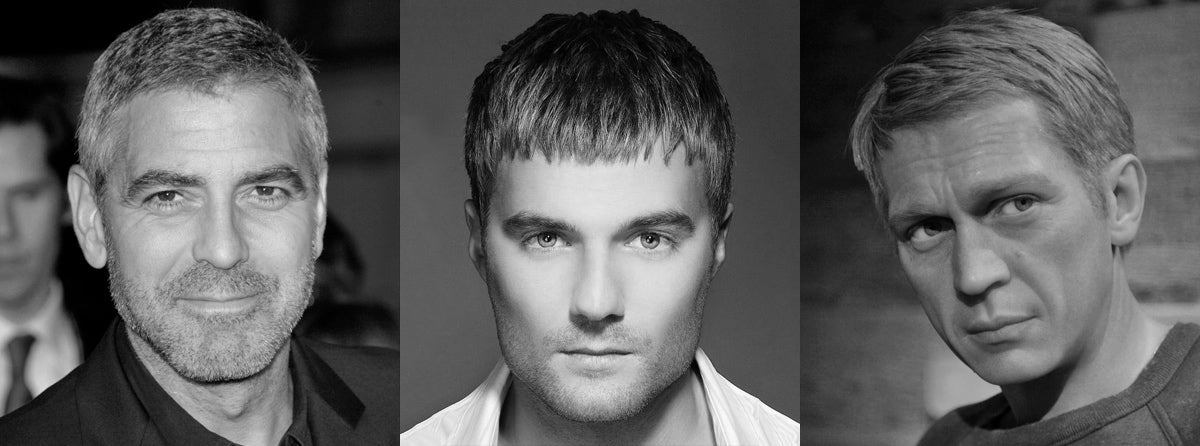
A buzz cut keeps the styling simple. A crew cut leaves more room to shape the top. If you want texture without a long fringe, compare a crop with a Caesar-inspired cut. Take a front and side image to the appointment so your barber can see the outline as well as the top.
A fade describes the transition in length at the sides and back. It can accompany several of these cuts; it is not the same thing as a specific hairstyle on top. Ask how high the fade will sit and how short the shortest section will be.

Fringes and messy texture: work with the direction of your hair
A fringe can be short and blunt, swept sideways or longer and broken up. Check how the front naturally falls before choosing a reference. For a deliberately tousled look, separate small sections after setting the overall shape.
By Vilain Dynamite Clay offers strong hold and a matte finish for textured styling. Start with a small amount: a messy appearance still benefits from a clear shape underneath.

Quiff, pompadour or slick back?
A quiff emphasises the raised front. A pompadour gives the swept-back top a fuller, more continuous shape. A slick back takes the hair away from the face with less emphasis on a lifted fringe.
Choose a quiff when you want front height with room for texture. Explore our pompadour guide for a more sculpted result, or the slick-back tutorial for a neater backward direction.
An undercut creates a stronger contrast between the longer top and shorter sides. Discuss whether you prefer that contrast or a softer transition.
Middle parts, waves and longer hair
Curtains and loose middle parts need enough length at the front to fall around the face. The part can sit slightly off-centre if that works better with your natural direction. You can keep the finish relaxed instead of forcing a ruler-straight division.
For light control with natural shine, By Vilain Flow Pomade suits styles where movement is part of the result. If you are aiming for shoulder length, use our nine-step grow-out guide to plan the stages between cuts.

Let curls and coils shape the choice
Shorter sides with a longer curly top, a rounded natural shape and longer curls are all options. Discuss how much length your hair appears to lose as it dries, and how you usually define or wear the curls. Our curly-hair styling guide covers the routine behind the finished look.
Narrow the choice with three decisions
How do you want to wear the front?
Choose a crop or fringe if you want hair directed towards the forehead. Choose a quiff or pompadour if you want lift and an open forehead. Consider curtains if you like length framing both sides of the face. Start here before deciding on a fade: the front often makes the biggest difference to how the hairstyle looks in a photograph.
Do you want to keep your natural texture?
With straight hair, compare clean lines with deliberately separated texture. With waves, decide whether the bend should stay visible. With curls or coils, choose the overall outline and length while allowing for how the hair sits when dry. A reference with a different texture may still provide inspiration, but ask which parts can realistically be reproduced.
How much maintenance will you actually do?
A very short cut can require little morning styling but frequent appointments to maintain a sharp outline. Longer hair may need less frequent reshaping while asking for more washing, detangling and drying time. Decide which kind of maintenance you prefer, rather than assuming “short” always means less work.
| Your priority | Compare these options | Question for your barber |
|---|---|---|
| Minimal morning styling | Buzz cut, crew cut, a crop adapted to your natural direction | How will this sit without a dryer? |
| Height at the front | Quiff and pompadour | How much length can I comfortably support and style? |
| Natural movement | Loose side part, curtains, layered waves or curls | Where should we keep weight so the shape moves well? |
| A cleaner outline with length on top | Tapered sides, a fade or a disconnected undercut | Do I want a gradual transition or a visible contrast? |
Use photos to compare shape, not just the person wearing it
In the archive fringe images above, compare where the front ends and how much hair covers the forehead. In the middle-part images, look at the length around the ears and the softness of the part. In the short-hair collage, compare the forward fringe with the side-swept version. These details give your barber something concrete to discuss.
Bring a second image showing a feature you do not want, if that helps explain the boundary—for example, a much higher fade or a shorter fringe. Tell your barber which image is the main reference so the two do not become conflicting instructions.
What to take to your barber
- One main reference, ideally with front and side views.
- The details you like: fringe length, side length, height or movement.
- The time and tools you will realistically use at home.
- Any area that regularly sticks out, falls flat or becomes difficult to style.
Ask your barber to explain any changes needed for your texture and growth pattern before cutting begins. A useful reference starts a conversation; it does not guarantee an identical result on different hair.
A note on the 2015–2019 hairstyle archive
Fringes, middle parts, messy texture, crops, fades and slick backs appeared repeatedly in our roundups from this period. The archive images here illustrate those shapes; they are not a new ranking of current trends. For an older era with a distinct identity, explore our 1950s-inspired hairstyles.
![The Greatest Handball Players [The World Championship 2017 in France]](http://slikhaarshop.com/cdn/shop/articles/slikhaar-wp-e4ee1cbb81cbe19a_69701a9d-ab84-4e92-b887-b3805a529a67.jpg?v=1789733292&width=740)